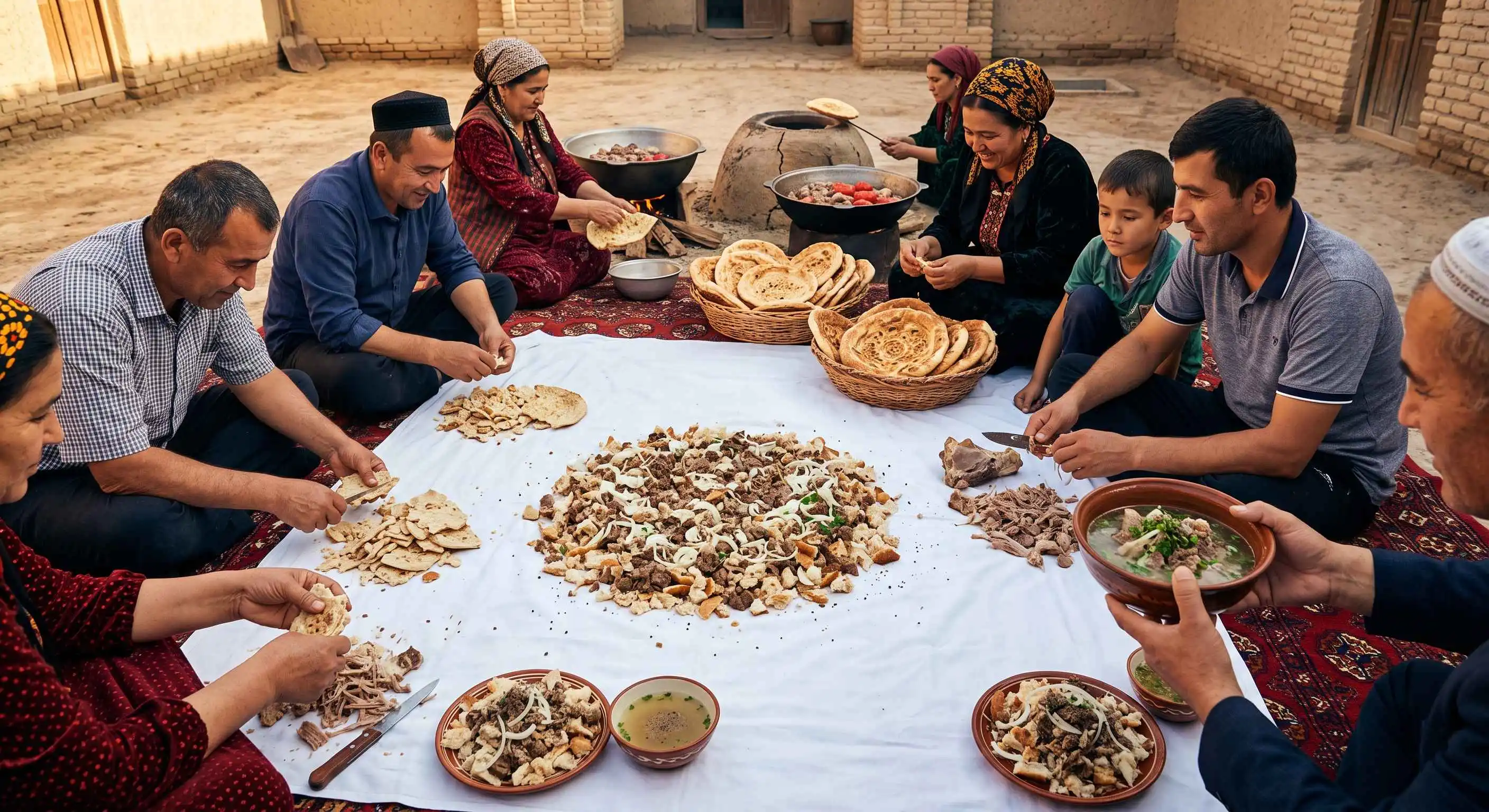
🍲 What Is Dograma: The Soul and Culinary Symbol of the Turkmen People
Turkmen cuisine is renowned for its authenticity, loyalty to centuries-old traditions, and an apparent simplicity that conceals the profound philosophy of nomadic and oasis life. Among the many delicacies of national gastronomy, a special, almost sacred place belongs to dograma (Turkmen: dograma). It is not merely a hearty meal—it is concentrated cultural identity, a ritual of unity, and a symbol of hospitality, without which no major family celebration, religious festival, or traditional memorial ceremony (sadaka) can be imagined.
The name itself comes from the Turkmen verb dogramak, which translates to "to cut," "to crumble," or "to shred." Visually, dograma is a masterfully balanced mixture of finely shredded unleavened flatbread (petir chorek), choice boiled meat, and juicy onions, served either dry or drenched in piping-hot, clear meat broth. As you travel across the country and explore its gastronomic map, you will quickly realize that dograma is a dish that Turkmens cherish above the finest delicacies of world cuisine.
For international travelers discovering the heart of Central Asia through our comprehensive guide to Ashgabat, trying dograma becomes one of the most vivid and memorable culinary experiences. It contains no complex exotic sauces or dozens of spices: perfection of flavor is achieved through the impeccable quality of three basic ingredients and a strict, centuries-old cooking technique.
🌾 The Sacred Triad of Ingredients: Simplicity Elevated to the Absolute
The philosophy of traditional Turkmen cuisine is rooted in respect for the pure taste of natural ingredients. Dograma is the quintessence of this approach, requiring just three fundamental components, along with water, salt, and black pepper:
| Component | Description |
|---|---|
| 🍞 Petir chorek (Petir çörek) | A special dense, unleavened bread baked in a clay tandoor (tamdyr). The dough is made without yeast, using only premium flour, water, salt, and occasionally sheep tail fat or butter. The finished flatbread turns out flaky, crispy, and dry enough not to become soggy when coming into contact with hot broth. |
| 🐑 Fresh meat (mutton or beef) | Traditionally, freshly butchered young lamb or choice bone-in beef is used. The meat is simmered in huge cauldrons (kazans) over low heat for several hours alongside ripe tomatoes (or without them, depending on the region) until it becomes incredibly tender and easily separates into fine shreds. |
| 🧅 Onions | Fresh, juicy, and slightly sweet local onions. They are thinly sliced into translucent half-rings or fine strips just before mixing, preserving their natural pungency, crunch, and essential oils. |
The secret of its unrivaled flavor lies in strict proportions: two parts of shredded bread are usually combined with one part of meat and half a part of fresh onions. Freshly ground black pepper is added to taste, imparting a refined spiciness and a warming sensation.
👨👩👧👦 The Cooking Ritual: A Sacrament of Communal Labor
Preparing dograma is not a routine kitchen chore, but a grand social and family event. In Turkmen households, it is rarely cooked in small batches for one or two people. If the aroma of freshly simmered meat for dograma fills a home, it means dozens of relatives, neighbors, and friends are expected. The process is divided into several strictly established stages, where every participant has a distinct role.
🍞 1. Baking the Petir Chorek
The day before or early in the morning, women knead a stiff dough and roll out large round flatbreads. The surface of the dough is decorated with traditional patterns using a special stamp (jenjele). The flatbreads are then placed in a scorching hot tamdyr, where they bake to a golden crust, absorbing a unique wood-smoke aroma.
🍲 2. Simmering the Rich Broth
Large cuts of meat are placed in a massive cauldron with clean spring water. It simmers slowly over moderate heat while the foam is constantly skimmed off to keep the broth (surpa) crystal clear, translucent, and amber-hued. Only salt and occasionally whole ripe tomatoes are added to the broth, imparting a subtle tang and a pleasant hue.
✋ 3. "Dogramalamak" — Shredding the Bread and Meat
This is the most heartwarming stage. The cooled petir chorek is broken into pieces, and then men, women, and older children gather around a clean white cloth (sachak) to tear the bread by hand into tiny pieces no larger than a fingernail. The boiled meat is carefully separated from the bones and likewise shredded by hand into fine fibers or sliced with a sharp knife. Using meat grinders or food processors is strictly forbidden—it is believed that mechanical processing destroys the texture and the "soul" of the dish.
🥣 4. The Final Mix
The shredded bread, tender meat fibers, and thinly sliced onions are combined in a large, wide basin. The master carefully mixes everything with both hands, rubbing it between the palms so that the onion and meat juices evenly saturate every crumb of bread. The mixture is then generously seasoned with black pepper.
If you wish to witness these living culinary traditions and experience the atmosphere of Oriental hospitality, consider our thoughtfully crafted 4-day Turkmenistan Tour: Ashgabat, Ancient Merv, and the Darvaza Crater, which blends visits to top attractions with authentic gastronomic experiences.
🍽️ How to Serve and Eat Dograma: Dry or with Broth?
There are two canonical ways to serve this national masterpiece, and every Turkmen has their own preference regarding the ideal version:
🌾 1. Dograma "Guruk" (Dry Style)
The prepared mixture of petir, meat, and onions is served dry on a wide platter. The bread, infused with meat aromas and fresh onion juices, retains a pleasant chew. This serving is always accompanied by a deep bowl of hot, rich broth sprinkled with fresh herbs (cilantro or dill), which is sipped alongside the meal. It is an excellent choice for a leisurely meal accompanied by hot green tea.
🍵 2. Dograma "Surpaly" (With Broth)
A generous portion of the mixture is placed in a deep ceramic bowl (kasa) and doused with boiling broth straight from the cauldron. The dish is left to rest for just a minute or two. The petir instantly absorbs the savory broth, turning soft without turning into mush, while the heat gently softens the onion's sharpness, bringing out its sweetness. It is an exceptionally warming, hearty, and revitalizing dish, particularly popular during cooler weather.
Traditionally, dograma is eaten with spoons and accompanied by freshly brewed green tea (gok chai). Fresh hot peppers, homemade fermented milk beverages (chal or gatyk), and fresh herbs are often served on the side.
🕌 Sacred Significance: A Dish for Celebrations, Joy, and Unity
In Turkmen culture, food carries deep sacred meaning. Dograma is the country's primary ceremonial dish. It is an indispensable part of Eid al-Adha (Kurban Bayram), when the sacrificial meat is shared among neighbors, relatives, and those in need. Huge cauldrons of dograma are also essential at weddings (toy), milestone jubilee celebrations (akgoyun toyy), and religious memorial gatherings (sadaka).
It is believed that the collective preparation of dograma brings people closer together, resolves past grievances, and strengthens community bonds. When dozens of people sit side by side for hours, shredding bread and meat by hand while enjoying unhurried conversations, a special atmosphere of warmth, brotherhood, and mutual understanding is born.
As you travel through the country's historic regions—for example, exploring Ancient Merv or heading into the Kopet Dag Mountains with our guide to the village of Nokhur—you will notice that every region has its own subtle recipe nuances, from onion ratios to the way meat is cut.
📍 Where Travelers Can Taste the Best Dograma
For visitors, tasting authentic dograma is an essential highlight of any itinerary. Here are the top spots to enjoy an exceptional serving:
- 🏙️ Ashgabat Banquet Halls (Toý Mekany) and National Restaurants: Many venues in the capital specialize in traditional cuisine. Look out for restaurants near the Teke and Russian (Gulistan) Bazaars, which serve the freshest morning dograma.
- 🛍️ Altyn Asyr Bazaar (Oriental Bazaar / Tolkuchka): The famous market on the outskirts of Ashgabat is an ideal place for culinary discoveries. Local teahouses (chaykhanas) prepare dograma on a grand scale following authentic folk recipes.
- 🏡 Regional Guesthouses: In the provinces of Mary, Lebap, Balkan, and Dashoguz, you will likely be treated to homemade dograma cooked over an open fire in a welcoming family setting.
If you are planning a overland journey across the country from the Uzbek border to the Caspian Sea or the Karakum Desert, great options include our 5-day Transit Tour across Turkmenistan: Ashgabat to Khiva via Merv and Darvaza or the compact 2-day Circular Tour of Turkmenistan, where experienced guides will introduce you to off-the-beaten-path teahouses offering exquisite local cuisine.
👩🍳 Homemade Dograma Recipe: How to Make It Yourself
If you want to recreate this culinary masterpiece at home after your trip to Turkmenistan, follow this tested classic recipe:
🛒 Ingredients
| Ingredient | Quantity |
|---|---|
| 🐑 Bone-in lamb or beef | 1 kg |
| 🌾 Premium wheat flour | 800 g |
| 💧 Water for dough | 400 ml |
| 🧅 Yellow onions | 4–5 medium bulbs |
| 🍅 Fresh tomatoes (optional) | 2 pieces |
| 🧂 Salt and freshly ground black pepper | to taste |
🔢 Step-by-Step Instructions
- 1️⃣ Petir Chorek: Knead a stiff, unleavened dough using flour, water, and a teaspoon of salt. Let it rest for 30 minutes, then roll into thick, flat rounds approximately 1.5–2 cm thick. Prick with a fork or bread stamp and bake in a preheated oven at maximum temperature (220–250°C / 430–480°F) until dry, crisp, and lightly golden. Let cool completely.
- 2️⃣ Broth: Rinse the meat, place it in a large pot, cover with cold water, and bring to a boil. Skim off all the foam thoroughly. Reduce the heat to low, add the tomatoes scored with a cross, and simmer for 2–2.5 hours until the meat is completely tender. Season with salt 20 minutes before taking off the heat.
- 3️⃣ Shredding: Finely crumble the cooled flatbread by hand. Remove the meat from the broth, let it cool slightly, and pull it into thin, short shreds. Slice the onions into very thin half-rings.
- 4️⃣ Combining: In a large mixing bowl, combine the shredded bread, meat, and onions. Mix vigorously with your hands, gently rubbing the ingredients together, and season generously with black pepper.
- 5️⃣ Serving: Divide among bowls, pour boiling strained broth over the top if desired, and serve alongside piping-hot green tea. Bon appétit — Işdäňiz açyk bolsun!